Global web icon
tequipment.net
https://www.tequipment.net/cat-ratings-explained/
CAT Ratings Explained | TEquipment
Choosing the right CAT rating ensures your test equipment can handle the energy levels present in the specific part of the electrical system you're working on, keeping both you and your gear protected. Selecting the correct CAT rating comes down to understanding your working environment.
Global web icon
protoolreviews.com
https://www.protoolreviews.com/electrical-measurem…
What are Electrical Measurement Categories (CAT III, Cat IV)?
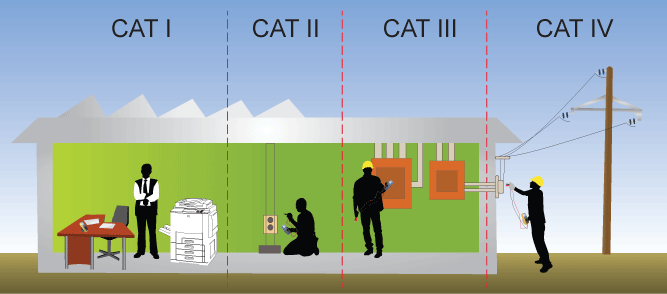
When shopping for electrical test & measurement tools you will often come across category designations from I – IV. These can be confusing or lead you to think that you need to look for a certain category, or that one is better than another. In terms of application, that might be correct.
Global web icon
ctlsys.com
https://ctlsys.com/support/measurement_categories_…
Measurement Categories (CAT I, II, III, IV) - Continental Control ...
Measurement categories are defined by the CE and UL safety standard IEC 61010-1 and are used to indicate the ability of an instrument (like the WattNode ® meter) to withstand voltage spikes without posing a shock hazard to the operator. An instrument should only be used at or below its rated measurement category and voltage.
Global web icon
tmatlantic.com
https://www.tmatlantic.com/encyclopedia/index.php?…
Measurement categories (CATI, CATII, CATIII, CATIV) - T&M Atlantic
Therefore there are four primary measurement categories for electrical tools: CATI, CATII, CATIII, and CAT IV. Measurement Categories are used to rate test instruments on their ability to resist a voltage spike, which is applied through a specific resistance.

Global web icon
ecmweb.com
https://www.ecmweb.com/archive/article/20894241/wh…
What You Need to Know About Category Ratings - EC&M
Test instruments are rated on their ability to withstand a voltage spike, which is applied through a specified level of resistance (Table). The ratings are broken down by categories — CAT I, II, III, and IV. CAT I-rated test instruments are signal-level tools for telecommunications and electronic equipment.
Global web icon
quizlet.com
https://quizlet.com/306611124/quiz-3_electrocution…
Quiz #3_Electrocution Hazards Flashcards | Quizlet
Study with Quizlet and memorize flashcards containing terms like Which of the following is NOT a category of electrical burns?, Electrocution was the second leading cause of worker deaths on construction sites in the United States in 2011., A worker was removing a metal antenna when it made electrical contact with a 7200-volt power transmission ...
Global web icon
ncsu.edu
https://ehs.ncsu.edu/occupational-health/electrica…
Electrical Personal Protective Equipment (PPE)
This electrical personal protective equipment procedure provides guidelines for determining when electrical PPE is required and how to select, use and maintain electrical PPE.
Global web icon
leafelectricalsafety.com
https://leafelectricalsafety.com/blog/arc-flash-pp…
Arc Flash PPE: Ratings & Categories of Electrical Safety Equipment
Once you’ve completed your arc flash risk assessment and you know the likelihood of occurrence is high enough to warrant PPE you’ll need to select something suitable for the hazard.
Global web icon
pakmcqs.com
https://pakmcqs.com/category/electrical-engineerin…
Electrical engineering Mcqs for Preparation of test Fpsc Nts -PakMcqs.com
Electrical engineering Mcqs for Preparation of Job Test and interview, freshers, Students, competitive exams etc. Multiple choice questions here are on topics such as Electrical Machines, Power Electronics, Electrical measurement & units, Utilization of Electrical Energy, Basic Electrical Engineering, Electrical Installation, Power Systems, Test...
Global web icon
mt.gov
https://bsd.dli.mt.gov/_docs/Training/Health-Care-…
NEC Article 517
patients that provides, on an outpatient basis, one or more of the following: •(1) Treatment for patients that renders the patients incapable of taking action for self-preservation under emergency conditions without the assistance of others.